

In today’s digital landscape, businesses thrive on compelling content that not only captures attention but also drives conversions. Content that converts goes beyond simply informing; it strategically guides potential customers through the sales funnel, ultimately leading to desired actions like purchases, sign-ups, or inquiries. Crafting a sales-driven content strategy is no longer a luxury, but a necessity for businesses seeking sustainable growth. This article explores the essential elements of creating content that converts and provides actionable insights for developing a content strategy that aligns with your sales objectives, turning readers into loyal customers.
Developing a content strategy that truly converts requires a deep understanding of your target audience, their needs, and their pain points. Content that converts speaks directly to these elements, offering solutions and building trust. This involves meticulous planning, keyword research for optimal search engine optimization (SEO), and a keen focus on creating valuable, engaging content across various platforms. By focusing on creating content that converts, your business can maximize its return on investment (ROI) and achieve significant growth. This article will equip you with the knowledge and tools to craft sales-driven content strategies that deliver measurable results, transforming your content from a passive asset into a powerful engine for conversions.
Understanding Your Sales Funnel and Buyer’s Journey
Before crafting any content, it’s crucial to understand your sales funnel and how it aligns with the buyer’s journey. The sales funnel represents the stages a prospect goes through, from initial awareness to becoming a customer.
Typically, a sales funnel includes stages like awareness, interest, decision, and action. The buyer’s journey mirrors this, reflecting the customer’s mindset and needs at each point.
At the awareness stage, potential customers are recognizing a problem or need. Interest is sparked as they research solutions. The decision phase involves evaluating different options. Finally, the action stage is where they make a purchase.
By understanding these stages, you can create targeted content that resonates with your audience at each point in their journey, effectively guiding them toward conversion.
Creating Content that Addresses Each Stage of the Sales Funnel
Aligning your content with each stage of the sales funnel is crucial for effectively guiding potential customers towards conversion. This involves understanding the specific needs and motivations of your audience at each point in their buying journey.
At the awareness stage, focus on educational content that addresses common pain points and introduces your brand as a solution. Think blog posts, infographics, and social media updates that offer valuable insights.
During the consideration phase, provide more in-depth content like white papers, webinars, and case studies that showcase your expertise and highlight the benefits of your product or service.
Finally, at the decision stage, offer product demos, free trials, and testimonials to nudge prospects towards a purchase. Clear and compelling calls to action are essential at this stage.
Developing Compelling Headlines and Calls to Action

Headlines are the first, and often only, impression you make on a potential customer. A compelling headline grabs attention, sparks curiosity, and promises value. It should clearly communicate the benefit of clicking through to read more.
Consider using numbers, strong adjectives, and posing questions to pique interest. For example, instead of “Improve Your Marketing,” try “5 Proven Strategies to Double Your Marketing Results.” This version is more specific and offers a quantifiable benefit.
Calls to action (CTAs) guide your audience towards the desired conversion. A strong CTA is clear, concise, and action-oriented. Use strong verbs like “Download,” “Register,” “Get Started,” or “Learn More.” The CTA should be visually prominent and easy to find.
Experiment with different CTA placements and phrasing. A/B testing can help you identify which CTAs resonate best with your target audience. Ensure your CTAs align with the content and user intent at each stage of the sales funnel.
Using Storytelling to Sell Your Products or Services
Storytelling is a powerful tool for connecting with your audience on an emotional level and driving sales. By crafting compelling narratives around your products or services, you can capture attention, build trust, and ultimately persuade potential customers to make a purchase.
Instead of simply listing features and benefits, storytelling allows you to showcase the value of your offerings in a relatable and memorable way. Focus on the transformation your product or service provides. How does it solve a problem, improve a situation, or fulfill a need? Weaving these elements into a narrative makes your message resonate more deeply.
Consider the elements of a good story: a protagonist (your customer), a conflict (their problem), a rising action (how your product/service helps), a climax (the solution), and a resolution (the positive outcome). This structure helps create engaging content that keeps the reader invested.
Authenticity is key. Share genuine stories that resonate with your target audience’s values and experiences. This could involve customer testimonials, case studies, or even anecdotes from your own company’s journey.
Optimizing Your Content for Search Engines and Conversions
Optimizing your content requires a dual focus: appealing to both search engines and your target audience. Search Engine Optimization (SEO) enhances visibility in search results, driving organic traffic. Conversion Rate Optimization (CRO) focuses on persuading visitors to take desired actions, such as making a purchase or signing up for a newsletter.
Effective SEO involves incorporating relevant keywords, building high-quality backlinks, and ensuring your website has a solid technical foundation. This includes optimizing site speed, mobile responsiveness, and URL structure.
CRO tactics involve clear and compelling calls to action, user-friendly website design, and A/B testing different elements to identify what resonates best with your audience. Understanding user behavior through analytics is crucial for improving conversions.
By strategically combining SEO and CRO, you can attract a larger audience and maximize the percentage of visitors who become valuable customers.
Leveraging Social Media to Promote Your Sales-Driven Content
Social media offers a powerful platform to amplify your sales-driven content and reach a wider audience. Choosing the right platforms is crucial. Analyze your target audience demographics to determine where they spend their time online. Focus your efforts on those platforms for maximum impact.
Tailor your content for each social media channel. What works on LinkedIn might not resonate on Instagram. Use engaging visuals and concise messaging to capture attention in fast-paced social media environments. Run targeted ad campaigns to reach specific segments of your audience based on demographics, interests, and behaviors. This allows you to pinpoint individuals most likely to convert into customers.
Engage with your followers by responding to comments and messages promptly. Building a strong community fosters trust and brand loyalty. Use social media analytics to track the performance of your content. Identify what resonates with your audience and adjust your strategy accordingly to optimize reach and engagement.
Measuring the ROI of Your Content Marketing Efforts
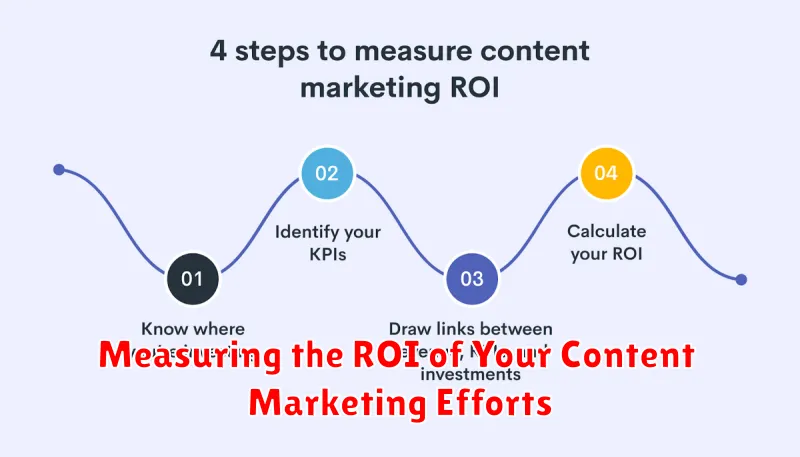
Measuring the return on investment (ROI) of your content marketing is crucial to understanding its effectiveness and justifying continued investment. While not always straightforward, several key metrics can help quantify the impact of your content.
Website Analytics provide valuable data on user behavior. Track metrics such as website traffic, bounce rate, time on page, and conversion rates. Increases in these metrics, particularly conversions, can indicate positive ROI.
Lead Generation is a key indicator of content effectiveness. Monitor the number of leads generated directly attributable to your content, such as through form submissions or content downloads. Assign a monetary value to each lead to calculate the return.
Sales Tracking directly links content to revenue. Implement systems to track which content pieces influence purchasing decisions. This can be achieved through CRM integration or dedicated tracking links. By attributing sales to specific content pieces, you can precisely measure ROI.
Social Media Engagement metrics, while not directly tied to revenue, provide insight into content reach and audience interaction. Track metrics like shares, likes, and comments to understand which content resonates with your audience.
A/B Testing Your Content to Improve Conversion Rates
A/B testing is a crucial step in optimizing your content for conversions. It involves creating two versions of a piece of content (A and B) with a single differing element, such as a headline, call to action, or image placement. These versions are then shown to separate, equally sized audience segments.
By analyzing the performance of each version, you can identify which element resonates better with your audience and leads to higher conversion rates. Key metrics to track during A/B testing include click-through rates, conversion rates, and bounce rates.
Elements to consider testing include headlines, calls to action, body copy, images, and form fields. Even small changes can make a significant impact on your conversion rates. A/B testing allows you to make data-driven decisions, continually refining your content for optimal performance.
Remember to test one element at a time to accurately isolate the impact of each change. Statistical significance is vital; ensure your sample size is large enough to draw valid conclusions from your test results.
Examples of Content that Sells
Case studies effectively showcase the positive impact of your product or service by highlighting real-world results and client testimonials. A compelling case study details the client’s initial challenges, the implemented solution, and the quantifiable benefits achieved.
Product demos and tutorials offer practical insights into how your product functions and its value proposition. Short, engaging videos or well-structured articles with clear steps can effectively convey the product’s usability and advantages.
Webinars and online workshops provide a platform to engage directly with potential customers. These interactive sessions offer valuable information related to your industry while subtly positioning your product or service as a solution to their needs.
Ebooks and white papers offer in-depth analysis on topics relevant to your target audience. By providing valuable information, you establish credibility and position yourself as a thought leader, subtly guiding readers towards your offerings.
Comparison charts present a clear and concise overview of how your product or service stacks up against competitors. Highlighting key features and benefits allows potential customers to make informed decisions, ideally leading them to choose your offering.
